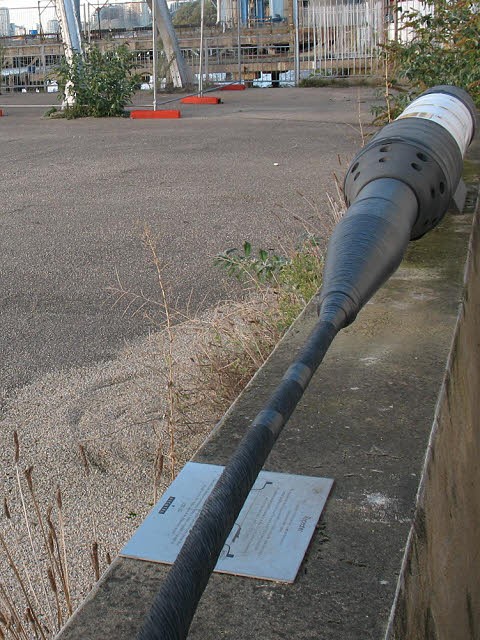
Every long-haul subsea cable loses signal strength continuously as light travels through glass fiber — a well-understood physical property called attenuation, typically around 0.18 to 0.20 dB of loss per kilometer for the fiber types used in modern subsea systems. Left unaddressed, that loss would make a transoceanic signal undetectable long before it reached the far end. Repeaters are the answer: submerged optical amplifier housings spliced directly into the cable at regular intervals, each one boosting the signal back up before it degrades too far to recover.
Spacing between repeaters is a direct engineering trade-off. Closer spacing keeps the signal stronger and cleaner at every point along the route, which supports higher per-wavelength data rates and more total fiber pairs — but every additional repeater is another powered, submerged component that has to survive decades on the seafloor and adds cost, and the entire cable has to carry electrical power to every repeater along its length from power feed equipment at the landing stations. Wider spacing reduces component count and cost but limits achievable capacity per fiber pair.
Our modern systems typically space repeaters every 60 to 80 kilometers, tightened toward the lower end of that range on our highest-capacity builds like Amberline, where dense C+L-band amplification across 20 fiber pairs pushes total signal power and gets more benefit from shorter amplification spans. The remote power feed equipment at each landing station has to supply enough voltage to drive every repeater along the entire cable length in series — on a system like Tradewind Express, that’s dozens of repeaters over 9,100 km, all powered from shore.
Repeater reliability is why subsea systems are designed for 25-year operating lives with no planned repeater replacement: a single failed repeater in deep water is a genuinely difficult, expensive repair, so the entire design — component selection, manufacturing quality control, and accelerated life testing before deployment — is built around repeaters simply not failing under normal conditions for the system’s full operating life.